http://www.nbcnews.com/business/economywatch/us-economys-contraction-just-brief-pause-1B8174851
For the first time since 2009, the United States' economy has actually shrunk. The article notes that this is a "brief pause" in an ongoing "recovery." What is the cause of this inexplicable halt? According to the article, it's a combination of Hurricane Sandy (totally plausible) and... defense cuts. Then it gets really wacky. Apparently, somehow taking money out of the economy and then spending it on stuff that blows up contributes to the economy. If one looks deeper into this article, it reveals the very, very poor methods used to measure economic progress.
Currently, one of the main measures of the economy is Gross National Product - that is, in essence, how much is being built. This is all well and good, until one realizes that government spending is factored into it, despite not actually producing anything, but rather taking money out of the economy, wasting a good portion, and then spending the remnant on various projects, going into impossibly deep debt in the process. In other words, spending money that does not exist is factored into our GDP. Thus, in World War II, despite the fact that Joe American was actually worse off (Depression + feeding huge numbers of soldiers who are not at the moment producing anything), is often listed as what "got us out of the Depression," since GDP went up. The problem is, that production, while necessary, consisted largely of tanks, aircraft carriers, and bombers (and the Manhattan Project).
The lesson to be learned from this article is that our system of measuring growth is fundamentally flawed. Under the assumptions of the authors, any economic problem can be solved by truly epic-scale debt spending (didn't that result in the French Revolution?) and higher taxes to partially fund the spending. Sure, GDP goes up impressively - but Joe American is decidedly not better off.
One final thing to note: the article mentions that the Federal Reserve is keeping interest rates artificially low, contributing to the "recovery." As horrible as it is, this means that, in part, the recovery is yet another bubble - exactly like the one that popped in 2008. A good thing to look up in reference to this is the Austrian Business Cycle Theory (ABCT), which is far too involved to explain here.
Wednesday, January 30, 2013

Friday, January 25, 2013
Looks like Ben is at it again.
http://washingtonexaminer.com/bernanke-get-rid-of-the-debt-ceiling-it-has-no-practical-value/article/2518534#.UPSEWB1Ft9h
Yes, Federal Reserve chairman Ben Bernanke is once again promoting questionable economics. We've all heard about the debt ceiling debates, where Republicans and Democrats bicker about whether or not it's a good idea to continue spending more money than the government actually has. It's happening again.
Mr. Bernanke - along with Treasury Secretary Tim Geithner - is now promoting the idea that the debt ceiling should be removed altogether, stating that it "has no practical value." Mr. Bernanke, is, in fact, partially correct. Up until recently, raising the debt ceiling was simply one of the things that Congress did, with relatively little debate, if any at all. It was purely symbolic. However, in the recent past, advocates of cutting spending have used the debt ceiling as leverage, threatening not to pass it unless spending reductions are made. Now it is very useful, as a means to avoid over-spending.
The point of the debt ceiling is to prevent the United States from going too far into debt; I have yet to see any person suggest that increasing an individual's debt is a good thing, and I fail to see how it is a good thing for a government either. To my knowledge, nobody else ever suggests that the solution to too much of something is to allow more of it. The fact is, what Mr. Bernanke is suggesting boils down to "We need to let the government spend as much as it wants, no matter the consequences."
Yes, Federal Reserve chairman Ben Bernanke is once again promoting questionable economics. We've all heard about the debt ceiling debates, where Republicans and Democrats bicker about whether or not it's a good idea to continue spending more money than the government actually has. It's happening again.
Mr. Bernanke - along with Treasury Secretary Tim Geithner - is now promoting the idea that the debt ceiling should be removed altogether, stating that it "has no practical value." Mr. Bernanke, is, in fact, partially correct. Up until recently, raising the debt ceiling was simply one of the things that Congress did, with relatively little debate, if any at all. It was purely symbolic. However, in the recent past, advocates of cutting spending have used the debt ceiling as leverage, threatening not to pass it unless spending reductions are made. Now it is very useful, as a means to avoid over-spending.
The point of the debt ceiling is to prevent the United States from going too far into debt; I have yet to see any person suggest that increasing an individual's debt is a good thing, and I fail to see how it is a good thing for a government either. To my knowledge, nobody else ever suggests that the solution to too much of something is to allow more of it. The fact is, what Mr. Bernanke is suggesting boils down to "We need to let the government spend as much as it wants, no matter the consequences."
Wednesday, January 9, 2013
And so it begins.
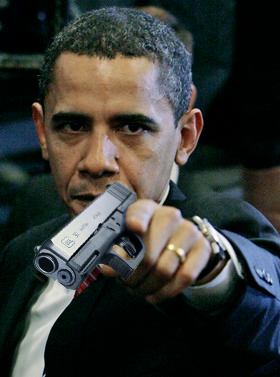
Wait, what begins? Well, this blog, first of all. Second, well, here it is: http://www.policymic.com/articles/22390/obama-may-make-executive-order-on-gun-control-president-would-make-policy-without-using-congress
This is the (possible) beginning of intense Federal gun restrictions. The article tries to be unbiased (good), but its leftward tilt seeps through in its selective reporting of statistics (bad). There are a few flaws with both the idea (executive order) and the article itself (misinterpretation and poor reporting of crime statistics).
But I'm getting ahead of myself. Let's do this piece-by-piece. First of all, the use of executive orders is entirely outside the scope of the Constitution. Presidents used them every now and then, but their use really took off with Theodore Roosevelt, and it's been downhill since then. Now, an executive order enforcing some form of gun control? That's unconstitutional on multiple levels. First, as mentioned, the executive order is in itself illegal. Second, the Federal government - even Congress - has no Constitutional authority to restrict firearms (or anything else, for that matter), even less so the President acting by himself; such regulation is a state issue. Third, well, the Second Amendment makes it pretty clear that the Federal Government cannot infringe on the right to bear arms. I know, I know, it's a tired cliche, but that doesn't make it less true. Again, it's a state issue, not Federal.
Now, for the misinterpretation. The author briefly makes fun of the Drudge Report headline featuring Josef Stalin and Adolf Hitler. First, it should be noted that both of them embarked on mass disarmament before they committed their atrocities, though extrapolating this to Obama's possible action is quite the stretch. However, it's fairly clear from context that the dictatorship theme is purely referencing the idea that the President can make laws on a whim - there, the comparison becomes entirely accurate. We have a Republic, not a monarchy.
As for the selective reporting of crime stats, the author is correct in the percentage of firearm-related homicides. However, the big current push is to ban "assault" weapons (that is, normal rifles that look scary). In this context, integrity would demand that the author acknowledge the fact that rifle homicides are incredibly rare, and are in fact significantly outnumbered by homicides using knives/blades, fists/feet, and hammers/clubs. They are a statistical anomaly, and "assault" weapons account for 1% of homicides. By the way, these stats are from the FBI, not Alex Jones. The vast majority of homicides are committed using small, cheap handguns (especially quiet little .22s), which means that any ban on AR-15s and the like would have no discernable impact on crime rates. We tried it in 1994 - it didn't work.
Subscribe to:
Posts (Atom)