You know, with all the far-reaching political subjects I talk about, sometimes it's little stories like this that make me question the future of humanity. The headline: "Auburn Man Facing Charges After Kiling Bear in His Backyard." So a crazy guy shot a bear that was rummaging around the trash or something, right? Wrong. A 76 year old guy was being chased by a 400 pound, 7-foot enraged bear that had cubs, right up until the point that he blasted it in the face with his shotgun.
I kid you not, he is being charged for an act of obvious self-defense.
Let me go through the charges one by one:
Charge #1: Illegally killing a bear. First, there's the saying, "Better to be tried by twelve than carried by six." Second - it was self-defense. I'm no expert on Massachusetts law, but my understanding is that even in that incomprehensible state, lethal force is permitted if something poses an imminent threat to your life. Let me repeat: 7-foot, 400 pound bear vs. 76 year old. He would have had his face eaten off if he hadn't shot the animal.
Charge #2: Illegally baiting a bear. Apparently, putting food in a bird feeder on your own property is considered baiting a bear now. Of course, the bear came out as he was putting food in the feeder, meaning that the bear was not, in fact, after the food, but after him.
Charge #3: Illegal possession of a firearm. Even in MA, it's still legal to own most shotguns, so unless he was packing a freaking Saiga 12, I don't really see what the problem is. The article makes no mention of any history of violent crime that would disqualify him, either. He was also on his own property.
Charge #4: Failing to secure a firearm. Ah, no. It was in his hands, it really doesn't get more secure than that. As noted in #2 and #3, he was on his own property, as well. Apparently, in MA, "safe storage" of a firearm means never taking it out of a safe, EVER.
You know, that last sentence was supposed to be sarcastic, but I can't help but wonder if it isn't actual policy.
As the icing on the cake, the cops have decided that the bear "wasn't a threat." Yes, I absolutely agree. The furious, four-hundred-pound mass of muscle, claws and teeth that was actively chasing a man was not a threat.
Let me remind the reader of something else: authorites say the thing had cubs. If there's one thing we all know about bears, it's that mother bears most definitely do not approve of the existence of anything larger than a Chihuahua on the same plane of existence as her cubs.
If any of the Auburn cops are reading this for some reason, the sarcasm probably went over their heads, so, other readers, I will spell it out for these cops: the angry bear was, in fact, a threat.
It used to be a moment like this would be considered a great story, if not an outright act of heroism, removing a threat to public safety. Instead, this guy is viewed by the authorities (at best) as a man who defended himself but still needs to be mercilessly attacked for killing a creature by means of a legal firearm.
What a sad, sad place this country is becoming.
Monday, April 8, 2013

Sunday, April 7, 2013
The double standard in war
Well, it's being reported prominently that several Americans, including a diplomat, as well as an Afghan doctor, have been killed by the Taliban. Fair enough - it's certainly newsworthy. In a display of fairness that is highly unusual in today's media, Drudge Report also linked to an article talking about civilians killed during the same timeframe. In other words, today's casualty list for the United States and its supporters:
Three American civilians
One Afghan doctor
Three American soldiers
Casualties for the Taliban:
Eight insurgents
On the other hand, there's another less-reported casualty list, that of the Afghan civilians, who apparently matter so little to Americans that a UK news site had to report it instead. Casualties? Ten children and two women.
Leaving aside the fact that the war is literally accomplishing nothing, one has to wonder - who decided that this kind of ratio is acceptable? Common sense would dictate that firing high explosives into population centers would result in disproportionate civilian deaths. The ratio we have here is for every two Taliban killed, three innocents died.
Fair trade? While I'm sure a number of Americans would say so, the families of those who died would likely beg to differ. See, here's the big problem in Afghanistan. Most of the hated "insurgents" are just civilians who are angry with U.S. occupation - and understandably so. The rather callous attitude towards civilian casualties only makes it worse, since the death of an innocent loved one, caused by an apparently malicious foreign power, is VERY likely to result in feelings of vengeance, and the Taliban are all too happy to take in these furious Afghans, equip them with rifles, and show them how to build bombs to kill more American soldiers.
In short, this war is self-perpetuating; not all that surprising, though, given that it's the longest-running war in U.S. history.
Three American civilians
One Afghan doctor
Three American soldiers
Casualties for the Taliban:
Eight insurgents
On the other hand, there's another less-reported casualty list, that of the Afghan civilians, who apparently matter so little to Americans that a UK news site had to report it instead. Casualties? Ten children and two women.
Leaving aside the fact that the war is literally accomplishing nothing, one has to wonder - who decided that this kind of ratio is acceptable? Common sense would dictate that firing high explosives into population centers would result in disproportionate civilian deaths. The ratio we have here is for every two Taliban killed, three innocents died.
Fair trade? While I'm sure a number of Americans would say so, the families of those who died would likely beg to differ. See, here's the big problem in Afghanistan. Most of the hated "insurgents" are just civilians who are angry with U.S. occupation - and understandably so. The rather callous attitude towards civilian casualties only makes it worse, since the death of an innocent loved one, caused by an apparently malicious foreign power, is VERY likely to result in feelings of vengeance, and the Taliban are all too happy to take in these furious Afghans, equip them with rifles, and show them how to build bombs to kill more American soldiers.
In short, this war is self-perpetuating; not all that surprising, though, given that it's the longest-running war in U.S. history.
Saturday, April 6, 2013
Still no Progress with Iran
I figure I've talked enough about one psycho dictator of a third-world country, so now I'll talk about Iran. We've all heard about how Iran is dangerous, and how Iran is gonna get a nuke and blow up Israel/the United States/Eastern Europe/everyone. As comedian Jon Stewart put it, "The range of opinion on foreign policy appears to be 'I unequivocally support Israel and might bomb Iran' to 'I unequivocally support Israel and will bomb Iran.'"
The common theme, of course, being that everyone wants to blow up Iranians, apparently. Unsurprisingly, the latest talks have achieved nothing. I think, however, that we need to understand why they're failing.
Point one - we don't actually know that Iran is building a nuke. Literally every single one of our (numerous) intelligence agencies have said that Iran either is not working on nukes, or that we can't prove one way or the other. It apparently has not crossed politicians' minds that maybe, just maybe, getting Iran to give up its weapons program isn't working because it doesn't have one in the first place.
Point two - it IS possible that Iran is in fact working on a nuclear weapon. We need to ask ourselves, "Why?" The general answer amongst politicians and conservative pundits is some variation of, "So they can blow up Israel." Well, if their leader is absolutely, certifiably bugnuts insane, then possibly. He certainly doesn't like the country. However, he IS a politician, and if politicians are anything, it's self-interested. Were he to attempt a nuclear attack on Israel, he would not only bring that country's full wrath (and the Mossad - yikes) down on his head, he would also be giving the U.S. a perfect excuse to go on an absolute rampage in the Middle East. I doubt he's that suicidal.
In addition, I think there's a larger reason they might want a nuke. Think about this: Nobody - not even the Chinese - like North Korea's government. As far as I can see, almost nobody would have any real issue with invading and giving Kim Jong Un the bin Laden treatment, or quietly assassinating him and starting a revolution, yet... they're untouchable.
Because they have nukes, and if they face an existential threat, they will use them. Gaddafi - the guy who got violently overthrown recently - actually had a nuke. At the request of the UN and NATO, he surrendered it, given that he was a "U.S. ally." Well, look what happened to him. He got revolutioned out of office, by way of U.S.-supplied rebels.
And that, ladies and gentlemen, is the real issue behind Iran's hypothetical nukes. 1953, CIA assassinates Iran's democratically-elected president, replacing him with a brutal pro-America authoritarian. Said brutal authoritarian is then overthrown and replaced with an anti-America authoritarian. The Iranian government - understandably - does not wish to be given the manufactured revolution treatment AGAIN. Thus, nukes. If they get even one weapon, they'll be effectively untouchable - sure, they won't win a war, but nobody'll try to start one, either. They've learned from other dictators. Cozying up to America is no guarantee of safety, but get a nuke, and you can be as violently anti-America/Israel/NATO as you please.
The common theme, of course, being that everyone wants to blow up Iranians, apparently. Unsurprisingly, the latest talks have achieved nothing. I think, however, that we need to understand why they're failing.
Point one - we don't actually know that Iran is building a nuke. Literally every single one of our (numerous) intelligence agencies have said that Iran either is not working on nukes, or that we can't prove one way or the other. It apparently has not crossed politicians' minds that maybe, just maybe, getting Iran to give up its weapons program isn't working because it doesn't have one in the first place.
Point two - it IS possible that Iran is in fact working on a nuclear weapon. We need to ask ourselves, "Why?" The general answer amongst politicians and conservative pundits is some variation of, "So they can blow up Israel." Well, if their leader is absolutely, certifiably bugnuts insane, then possibly. He certainly doesn't like the country. However, he IS a politician, and if politicians are anything, it's self-interested. Were he to attempt a nuclear attack on Israel, he would not only bring that country's full wrath (and the Mossad - yikes) down on his head, he would also be giving the U.S. a perfect excuse to go on an absolute rampage in the Middle East. I doubt he's that suicidal.
In addition, I think there's a larger reason they might want a nuke. Think about this: Nobody - not even the Chinese - like North Korea's government. As far as I can see, almost nobody would have any real issue with invading and giving Kim Jong Un the bin Laden treatment, or quietly assassinating him and starting a revolution, yet... they're untouchable.
Because they have nukes, and if they face an existential threat, they will use them. Gaddafi - the guy who got violently overthrown recently - actually had a nuke. At the request of the UN and NATO, he surrendered it, given that he was a "U.S. ally." Well, look what happened to him. He got revolutioned out of office, by way of U.S.-supplied rebels.
And that, ladies and gentlemen, is the real issue behind Iran's hypothetical nukes. 1953, CIA assassinates Iran's democratically-elected president, replacing him with a brutal pro-America authoritarian. Said brutal authoritarian is then overthrown and replaced with an anti-America authoritarian. The Iranian government - understandably - does not wish to be given the manufactured revolution treatment AGAIN. Thus, nukes. If they get even one weapon, they'll be effectively untouchable - sure, they won't win a war, but nobody'll try to start one, either. They've learned from other dictators. Cozying up to America is no guarantee of safety, but get a nuke, and you can be as violently anti-America/Israel/NATO as you please.
Friday, April 5, 2013
This is quite odd.
With a few exceptions, politicians generally don't care about the Constitution or the writings of the Founding Fathers. It's certainly not a partisan flaw - George W. Bush violated the Constitution just as gleefully as Obama's been doing. In fact, I can't think of a single president in the past half century that's had even a slight amount of respect for the law of the land.
This, of course, make's Barack Obama's recent comments all the stranger. In an attempt to reduce opposition to his gun-restriction agenda, Mr. Obama told gun owners that he was constrained by the system the Founders put in place. He dismisses concerns about overreach by government - in order to defend overreach by government. Cognitive dissonance, much?
Mr. Obama seems rather arrogant, if not intentionally so, in this dismissal. Consider this: the Founders, shortly after winning a revolution fought primarily by citizen militias equipped with privately owned firearms, wrote an amendment stating that the "right of the people to keep and bear arms shall not be infringed." The obvious intent was to provide a state-level counterbalance to Federal power.
These comments are a fascinating insight into the mind of politicians. Mr. Obama literally is arguing that there's nothing wrong with subverting the Founders' intent because it won't be subverting the Founders' intent, even though it is. It's a bizarre, almost circular line of reasoning, similar to the idea that freedom can only be protected by taking it away. By saying that it's silly to worry about having a means to defend yourself from government, he is stating that the Founders' concerns were silly, while paying lip service to the Founders' system.
Then, there's his comment that tyrrany can't happen because "the government is us." Well, no, it's not. We live in a republic, not a democracy. "The government" is, in fact, the few hundred senators and representatives, judges, the president, department heads and Heaven-knows-how-many bureaucrats. While I normally would avoid Godwin's Law like the plague, I can't help but dispute the argument that democracy prevents tyrrany by pointing out that, of all people, Adolf Hitler was also fairly elected.
I am not calling Mr. Obama an equivalent of Hitler by any means. However, his statements reflect the concerning attitude of complacency common in America, that "it could never happen here." It's a dangerous sentiment.
This, of course, make's Barack Obama's recent comments all the stranger. In an attempt to reduce opposition to his gun-restriction agenda, Mr. Obama told gun owners that he was constrained by the system the Founders put in place. He dismisses concerns about overreach by government - in order to defend overreach by government. Cognitive dissonance, much?
Mr. Obama seems rather arrogant, if not intentionally so, in this dismissal. Consider this: the Founders, shortly after winning a revolution fought primarily by citizen militias equipped with privately owned firearms, wrote an amendment stating that the "right of the people to keep and bear arms shall not be infringed." The obvious intent was to provide a state-level counterbalance to Federal power.
These comments are a fascinating insight into the mind of politicians. Mr. Obama literally is arguing that there's nothing wrong with subverting the Founders' intent because it won't be subverting the Founders' intent, even though it is. It's a bizarre, almost circular line of reasoning, similar to the idea that freedom can only be protected by taking it away. By saying that it's silly to worry about having a means to defend yourself from government, he is stating that the Founders' concerns were silly, while paying lip service to the Founders' system.
Then, there's his comment that tyrrany can't happen because "the government is us." Well, no, it's not. We live in a republic, not a democracy. "The government" is, in fact, the few hundred senators and representatives, judges, the president, department heads and Heaven-knows-how-many bureaucrats. While I normally would avoid Godwin's Law like the plague, I can't help but dispute the argument that democracy prevents tyrrany by pointing out that, of all people, Adolf Hitler was also fairly elected.
I am not calling Mr. Obama an equivalent of Hitler by any means. However, his statements reflect the concerning attitude of complacency common in America, that "it could never happen here." It's a dangerous sentiment.
Wednesday, April 3, 2013
Housing crisis all over again?
There's an old saying that goes something like this: "Those who do not learn history are doomed to repeat it." Makes sense, right? We need to learn from past mistakes. Even things that happened hundreds or thousands of years ago can teach us valuable lessons about economics, human nature, warfare and politics. It's really important to be able to learn from the distant past.
Then again, there's also some merit to paying attention to things that happened, oh, four or five years ago, too.
See, President Obama wants to push banks to make loans to risky borrowers. Based on even a brief glance at the past few years, this is obviously a Very Bad Idea.
Now, why is this a Very Bad Idea? Take a look at the housing bubble and bust from 2007-08. The housing market had become a tremendously inflated bubble thanks to two policies. The first of these is the artificially low interest rates created by the Federal Reserve. Guess what's happening right now? In an effort to stimulate the economy, the Federal Reserve is... wait for it... creating artificially low interest rates.
Oops. This by itself is a recipe for disaster, but the next policy makes it worse. During The Bubble, one of the policies enforced by the government was forcing banks to provide those artificially low-interest loans to people who were very risky borrowers with low credit ratings.
This sounding familiar? That's exactly the policy that the administration wants to pursue. Now, I dislike the strangely popular "blame Bush for everything" tactic, but in all fairness the policies that created the housing bubble and subsequent bust were Bush policies. What baffles me is the fact that Mr. Obama insists on following this same course. I know history repeats itself, but I honestly did not expect it to happen this quickly.
The deeper issue, of course, is the idea that the government can "stimulate" the economy at all. Our system is a pseudo-free market - that is, it's technically capitalist, with everyone being more or less free to trade as they see fit (free market) but with such absurdly heavy government involvement (socialism, progressivism, whatever) that it's definitely not an actual free market; the proper term is corporatism, or, if you like loaded words, it would be technically accurate to call ours a fascist system. When the government decides to "stimulate" the economy in whatever way, it invariably results in distortions in the market, creating false demand and generally resulting in unnatural developments.
The result? Because we don't have a full socialist (everything is government-owned) economy, the market will correct what's happening. Those bubbles? Yeah, they bust, making things even worse, and when they bust, it gets blamed on the free market, which in turn results in increased regulations that stifle growth, as well as policies like Mr. Obama's proposed ideas, which cause still more bubbles, which then bust, and so the cycle continues, as history endlessly repeats itself.
As an aside, it should be noted that when America's economy was stable, it had no central bank. In the years between central banks, it was stable. Every time a central bank showed up? Boom-bust cycle yet again.
I've decided that my new criteria for supporting a presidential candidate will be looking at their knowledge of history.
Then again, there's also some merit to paying attention to things that happened, oh, four or five years ago, too.
See, President Obama wants to push banks to make loans to risky borrowers. Based on even a brief glance at the past few years, this is obviously a Very Bad Idea.
Now, why is this a Very Bad Idea? Take a look at the housing bubble and bust from 2007-08. The housing market had become a tremendously inflated bubble thanks to two policies. The first of these is the artificially low interest rates created by the Federal Reserve. Guess what's happening right now? In an effort to stimulate the economy, the Federal Reserve is... wait for it... creating artificially low interest rates.
Oops. This by itself is a recipe for disaster, but the next policy makes it worse. During The Bubble, one of the policies enforced by the government was forcing banks to provide those artificially low-interest loans to people who were very risky borrowers with low credit ratings.
This sounding familiar? That's exactly the policy that the administration wants to pursue. Now, I dislike the strangely popular "blame Bush for everything" tactic, but in all fairness the policies that created the housing bubble and subsequent bust were Bush policies. What baffles me is the fact that Mr. Obama insists on following this same course. I know history repeats itself, but I honestly did not expect it to happen this quickly.
The deeper issue, of course, is the idea that the government can "stimulate" the economy at all. Our system is a pseudo-free market - that is, it's technically capitalist, with everyone being more or less free to trade as they see fit (free market) but with such absurdly heavy government involvement (socialism, progressivism, whatever) that it's definitely not an actual free market; the proper term is corporatism, or, if you like loaded words, it would be technically accurate to call ours a fascist system. When the government decides to "stimulate" the economy in whatever way, it invariably results in distortions in the market, creating false demand and generally resulting in unnatural developments.
The result? Because we don't have a full socialist (everything is government-owned) economy, the market will correct what's happening. Those bubbles? Yeah, they bust, making things even worse, and when they bust, it gets blamed on the free market, which in turn results in increased regulations that stifle growth, as well as policies like Mr. Obama's proposed ideas, which cause still more bubbles, which then bust, and so the cycle continues, as history endlessly repeats itself.
As an aside, it should be noted that when America's economy was stable, it had no central bank. In the years between central banks, it was stable. Every time a central bank showed up? Boom-bust cycle yet again.
I've decided that my new criteria for supporting a presidential candidate will be looking at their knowledge of history.
Tuesday, April 2, 2013
And we're back to guns.
Of course, this time it's pretty much justified. Three rather important events have just happened relating to the subject.
First, the United Nations passed the very vaguely worded "Arms Trade Treaty," which is ostensibly to regulate illicit arms sales to terrorist groups. That said, the wording of the treaty in question is very, ah, broad, leaving it open to abuse.
Second, a little town in Georgia passed a mostly symbolic law mandating firearms ownership, making it the second town in that state to do so. It should be interesting to watch what happens.
Third, and most importantly, Connecticut just got a sweeping set of gun laws. This is what I'll be writing about, given that it's almost certain that the legislature will approve everything. Post-Newtown shooting, the big rallying cries were for three things: increased mental health care, better school security, and gun control. Well, unsurprisingly, Connecticut, where the shooting happened, is following in the footsteps of New York (SAFE Act) and Colorado (magazine ban) in going for dramatic gun control measures.
Now, most of what we see in the proposals consists of the standard fare, such as "universal background checks," magazine restrictions, and so on. However, there are some new features that aren't common in new proposals.
The first of these is mandating a registry for magazines over 10 rounds; aside from the initial versions of Senator Feinstein's ban, this hasn't really shown up in any important legislation. It has not been explained how on Earth they plan to enforce it, however. Magazine purchases are regulated exactly the same as buying most household items - that is, they aren't. They have no way of tracking these down, and odds are quite a few gun owners will pretend they only have 10-rounders. Interestingly, in the context of the Newtown shootings, it should be noted that the murderer changed magazines repeatedly without emptying them, often leaving them half full at 15 rounds. If the massacre had been committed with 10-round magazines, it's doubtful that the death toll would be any smaller.
The second of the unusual features is a requirement for state permission to buy ammo. As far as I know, this has not been seriously proposed until now. I have the same issue with this that I do with "may issue" concealed carry licenses. While the merits of state authorization are up for debate, the idea that a government can deny the ability to purchase ammunition to anyone they choose seems to me to be giving the government far too much power.
First, the United Nations passed the very vaguely worded "Arms Trade Treaty," which is ostensibly to regulate illicit arms sales to terrorist groups. That said, the wording of the treaty in question is very, ah, broad, leaving it open to abuse.
Second, a little town in Georgia passed a mostly symbolic law mandating firearms ownership, making it the second town in that state to do so. It should be interesting to watch what happens.
Third, and most importantly, Connecticut just got a sweeping set of gun laws. This is what I'll be writing about, given that it's almost certain that the legislature will approve everything. Post-Newtown shooting, the big rallying cries were for three things: increased mental health care, better school security, and gun control. Well, unsurprisingly, Connecticut, where the shooting happened, is following in the footsteps of New York (SAFE Act) and Colorado (magazine ban) in going for dramatic gun control measures.
Now, most of what we see in the proposals consists of the standard fare, such as "universal background checks," magazine restrictions, and so on. However, there are some new features that aren't common in new proposals.
The first of these is mandating a registry for magazines over 10 rounds; aside from the initial versions of Senator Feinstein's ban, this hasn't really shown up in any important legislation. It has not been explained how on Earth they plan to enforce it, however. Magazine purchases are regulated exactly the same as buying most household items - that is, they aren't. They have no way of tracking these down, and odds are quite a few gun owners will pretend they only have 10-rounders. Interestingly, in the context of the Newtown shootings, it should be noted that the murderer changed magazines repeatedly without emptying them, often leaving them half full at 15 rounds. If the massacre had been committed with 10-round magazines, it's doubtful that the death toll would be any smaller.
The second of the unusual features is a requirement for state permission to buy ammo. As far as I know, this has not been seriously proposed until now. I have the same issue with this that I do with "may issue" concealed carry licenses. While the merits of state authorization are up for debate, the idea that a government can deny the ability to purchase ammunition to anyone they choose seems to me to be giving the government far too much power.
Thursday, March 28, 2013
Your hard-earned money at work.
First of all, yes, I realize that anything less than a billion dollars is pretty much meaningless in terms of total spending.
However, I cannot help but be mildly surprised at the level of stupidity of some of the things our money is being spent on, like, oh, spending $880,000 to study snail sex. As with many of my posts, this represents a larger issue, but first, I want to emphasize something.
They just spent well over 16 times the average household income to study why the New Zealand mud snail has sex instead of reproducing asexually. Not only will this provide no actual benefit whatsoever to any human being in existence, nobody actually cares. I'd be willing to bet that until this post, you'd never heard of the New Zealand mud snail.
Now, the bigger issue. Remember my last post, about the Congressman who thought he was above everyone? I mentioned in that post that because of their superiority complex, our governing officials don't actually care what we think. Because of this, they gleefully throw money around like a drunken 18th century pirate on shore leave - the spending is unproductive, expensive, and frivolous, and it's not actually their money that they're spending.
See, this is just further evidence that they don't care. They're not willing to sift through bills and take out unnecessary spending; the government happily gives scientists grants without regard to the merit of the study in question.
Our government, in short, feels that it is completely justified in spending however much money it wants on whatever it so chooses, ignoring public opinion, common sense, and fiscal responsibility - and again, ignoring the Constitution.
Finally, I must end on this sentiment. Why do we need to know why New Zealand mud snails have sex?!
However, I cannot help but be mildly surprised at the level of stupidity of some of the things our money is being spent on, like, oh, spending $880,000 to study snail sex. As with many of my posts, this represents a larger issue, but first, I want to emphasize something.
They just spent well over 16 times the average household income to study why the New Zealand mud snail has sex instead of reproducing asexually. Not only will this provide no actual benefit whatsoever to any human being in existence, nobody actually cares. I'd be willing to bet that until this post, you'd never heard of the New Zealand mud snail.
Now, the bigger issue. Remember my last post, about the Congressman who thought he was above everyone? I mentioned in that post that because of their superiority complex, our governing officials don't actually care what we think. Because of this, they gleefully throw money around like a drunken 18th century pirate on shore leave - the spending is unproductive, expensive, and frivolous, and it's not actually their money that they're spending.
See, this is just further evidence that they don't care. They're not willing to sift through bills and take out unnecessary spending; the government happily gives scientists grants without regard to the merit of the study in question.
Our government, in short, feels that it is completely justified in spending however much money it wants on whatever it so chooses, ignoring public opinion, common sense, and fiscal responsibility - and again, ignoring the Constitution.
Finally, I must end on this sentiment. Why do we need to know why New Zealand mud snails have sex?!
Wednesday, March 27, 2013
Congressmen above the law?
Well, well. Nobody is at all surprised when Congressmen think the law doesn't apply to them, but even so, sometimes they still manage to surprise me.
According to Mr. Gohmert's aide, the officers apologized and rescinded the ticket upon realizing their folly, and all was well with the world.
According to the officers, however, Mr. Gohmert was kind of a jerk, and wasn't actually allowed to park there even as a Congressman. The Park Police say that he would not have been permitted to park in a reserved spot near the Lincoln Memorial despite his status. As a side note: this was done to avoid a fine of - gasp! - twenty five dollars!
No, really. A Congressman flips out, acts rude towards cops, and simply walks off in direct defiance of the law all over twenty. Five. Dollars.
As with many articles, this is really about a much, much bigger issue than ignoring a $25 fine. This is about how our lawmakers see themselves. Again and again, we see it demonstrated that they believe they are above the laws that they themselves write. This is a dangerous mentality; even in 18th-century Great Britain, the King himself was subject to laws.
It's gotten very, very bad. You see, this is just a semi-amusing, pretty irritating and unusually visible expression of the belief that our lawmakers do not have to follow the law. When the U.S. was founded, the intent was that the government would be, in the words of Thomas Jefferson, "bound by the chains of the Constitution." The Constitution was supposed to be the highest law in the country. Now, however, it's whatever they feel like. If you were to select five bills completely randomly that were passed in the last year, odds are frighteningly good that they are flagrant violations of Constitutional restrictions.
This is more than the fake Democrat-Republican paradigm. Gohmert is a Republican; both parties routinely violate the aspects of the Constitution that they don't like, and it's to the point that it's almost not worth trying to figure out a bill's legality under the Constitution.
There is a reason that Congress's approval is so low, right now. A disturbing number of them think that they are "above" the rest of the population, and so they don't care nearly as much as they should about the actual effect their laws will have.
According to Mr. Gohmert's aide, the officers apologized and rescinded the ticket upon realizing their folly, and all was well with the world.
According to the officers, however, Mr. Gohmert was kind of a jerk, and wasn't actually allowed to park there even as a Congressman. The Park Police say that he would not have been permitted to park in a reserved spot near the Lincoln Memorial despite his status. As a side note: this was done to avoid a fine of - gasp! - twenty five dollars!
No, really. A Congressman flips out, acts rude towards cops, and simply walks off in direct defiance of the law all over twenty. Five. Dollars.
As with many articles, this is really about a much, much bigger issue than ignoring a $25 fine. This is about how our lawmakers see themselves. Again and again, we see it demonstrated that they believe they are above the laws that they themselves write. This is a dangerous mentality; even in 18th-century Great Britain, the King himself was subject to laws.
It's gotten very, very bad. You see, this is just a semi-amusing, pretty irritating and unusually visible expression of the belief that our lawmakers do not have to follow the law. When the U.S. was founded, the intent was that the government would be, in the words of Thomas Jefferson, "bound by the chains of the Constitution." The Constitution was supposed to be the highest law in the country. Now, however, it's whatever they feel like. If you were to select five bills completely randomly that were passed in the last year, odds are frighteningly good that they are flagrant violations of Constitutional restrictions.
This is more than the fake Democrat-Republican paradigm. Gohmert is a Republican; both parties routinely violate the aspects of the Constitution that they don't like, and it's to the point that it's almost not worth trying to figure out a bill's legality under the Constitution.
There is a reason that Congress's approval is so low, right now. A disturbing number of them think that they are "above" the rest of the population, and so they don't care nearly as much as they should about the actual effect their laws will have.
Tuesday, March 26, 2013
North Korea is at it again
Clearly, the leadership in Pyongyang is a few fries short of a Happy Meal. Kim Jong Un's latest lunacy involves declaring that his forces are in position to hit the US mainland, as well as Guam, Hawai'i, Japan, and South Korea.
They could, in fact, hit South Korea, and maybe Japan, but North Korea simply does not have the long-range missile capability to hit any of the other places. The Pacific Ocean is really freaking big, and NKorea only has short and medium range missiles, not the ICBMs necessary to hit distant targets.
That said, I'm quite frankly getting unnerved by these guys. Kim Jong Un's rhetoric indicates that he may very well be unstable, given that threatening THE superpower and two of its best buddies (Japan and SKorea) is generally considered a less-than-rational action. While we may be totally out of range, South Korea is not. Seoul is within easy range of NKorea's most primitive artillery, not to mention their very functional medium-range missiles and rocket batteries. The capital of South Korea has 10.5 million people living in it; a single day of bombardment would cost the lives of thousands.
I'm honestly not sure how to take these threats. It's very possible that Pyongyang is simply blowing off steam and acting tough to save face; given the honor-based culture in the region, that wouldn't be at all surprising, considering the recent sanctions. On the other hand, the Dear Leader's actions are very much in keeping with those of a deranged maniac, and while a lunatic third-world dictator would not normally be that big a deal, this is one lunatic with missiles, rockets, cannons and nukes pointed straight at a crowded metropolis.
I still am hopeful, however. Tensions have been severe on the peninsula before and didn't lead to war, so I think that, in the end, the worst that will happen is that the Koreas are at each others' throats for a while until things calm down, at least until the next big crisis. Only time will tell, though.
They could, in fact, hit South Korea, and maybe Japan, but North Korea simply does not have the long-range missile capability to hit any of the other places. The Pacific Ocean is really freaking big, and NKorea only has short and medium range missiles, not the ICBMs necessary to hit distant targets.
That said, I'm quite frankly getting unnerved by these guys. Kim Jong Un's rhetoric indicates that he may very well be unstable, given that threatening THE superpower and two of its best buddies (Japan and SKorea) is generally considered a less-than-rational action. While we may be totally out of range, South Korea is not. Seoul is within easy range of NKorea's most primitive artillery, not to mention their very functional medium-range missiles and rocket batteries. The capital of South Korea has 10.5 million people living in it; a single day of bombardment would cost the lives of thousands.
I'm honestly not sure how to take these threats. It's very possible that Pyongyang is simply blowing off steam and acting tough to save face; given the honor-based culture in the region, that wouldn't be at all surprising, considering the recent sanctions. On the other hand, the Dear Leader's actions are very much in keeping with those of a deranged maniac, and while a lunatic third-world dictator would not normally be that big a deal, this is one lunatic with missiles, rockets, cannons and nukes pointed straight at a crowded metropolis.
I still am hopeful, however. Tensions have been severe on the peninsula before and didn't lead to war, so I think that, in the end, the worst that will happen is that the Koreas are at each others' throats for a while until things calm down, at least until the next big crisis. Only time will tell, though.
Attack of the Drones
Sorry, couldn't resist the Star Wars pun. And no, if you're wondering, we have not yet been attacked by drones. However, since Senator Rand Paul's filibuster opposing their use, they've been in the news quite a bit. Slate, of all places, notes the dramatic swing in public opinion. Yes, you read that right. Since last year, opposition to targeted killings via drone has doubled, and support has dropped by a third.
In one year.
While there has been some opposition to the growing surveillance state for years - the "Patriot" Act comes to mind - it's never been as solid and far-reaching as now.
The thing is, in and of themselves, drones are not actually that big a deal. A manned aircraft can do the exact same thing. The importance of the drone, however, is symbolic. One can't really rally people to a cause using a security camera as the symbol of "the enemy." Those things are, in fact, quite necessary in places like banks and other high-value locations, and their appearance has been gradual enough that they don't inspire anything other than brief moments of being slightly creeped out.
But drones? They represent everything the anti-surveillance crowd has opposed, and their appearance in potential law enforcement use is sudden and surprising. Drones are freaky looking, obviously robotic, with almost no human element. The operator sits in a building miles upon miles away, totally secure. There's something about them that simply seems wrong. The opposition to drones is about more than drones, really - it's about the idea that you are being watched impersonally, and that the watcher could simply push a button and hit you with a very literal Hellfire.
In addition, it's a due process issue. Even though Rand and co. make this very clear, many times it's glossed over. But that's the core of it - the drone is merely the creepiest tool, the same logic applies to any assassination of a person, especially a U.S. citizen, without due process.
Oddly, most articles don't seem to note that, but if you pay close attention, it's very clear that the drones are only one of many things that Senator Paul and those who agree with him oppose, but it is a very powerful symbol. It's about surveillance, due process and a perceived violation of personal freedom, and drones are just the first thing to come along that embodies everything that the anti-surveillance, anti-assassination crowd opposes.
In one year.
While there has been some opposition to the growing surveillance state for years - the "Patriot" Act comes to mind - it's never been as solid and far-reaching as now.
The thing is, in and of themselves, drones are not actually that big a deal. A manned aircraft can do the exact same thing. The importance of the drone, however, is symbolic. One can't really rally people to a cause using a security camera as the symbol of "the enemy." Those things are, in fact, quite necessary in places like banks and other high-value locations, and their appearance has been gradual enough that they don't inspire anything other than brief moments of being slightly creeped out.
But drones? They represent everything the anti-surveillance crowd has opposed, and their appearance in potential law enforcement use is sudden and surprising. Drones are freaky looking, obviously robotic, with almost no human element. The operator sits in a building miles upon miles away, totally secure. There's something about them that simply seems wrong. The opposition to drones is about more than drones, really - it's about the idea that you are being watched impersonally, and that the watcher could simply push a button and hit you with a very literal Hellfire.
In addition, it's a due process issue. Even though Rand and co. make this very clear, many times it's glossed over. But that's the core of it - the drone is merely the creepiest tool, the same logic applies to any assassination of a person, especially a U.S. citizen, without due process.
Oddly, most articles don't seem to note that, but if you pay close attention, it's very clear that the drones are only one of many things that Senator Paul and those who agree with him oppose, but it is a very powerful symbol. It's about surveillance, due process and a perceived violation of personal freedom, and drones are just the first thing to come along that embodies everything that the anti-surveillance, anti-assassination crowd opposes.
Monday, March 25, 2013
I would say I feel betrayed...
...but I've never really felt that John McCain and I were on the same page. I realize I've written a disproportionate number of posts about gun control, but I ended up writing this for two reasons, those being,
A) I feel that gun control is a really important issue right now, and
B) I promised to pick on a Republican in my last post.
With Feinstein's AWB dead in the water (for now, I'm fairly sure it'll be resurrected as an amendment), the big focus now is on "universal background checks." As you've probably guessed by now, McCain supports the increased checks. I'll briefly deal with the background checks themselves, but then I want to delve into some less obvious points in the article.
The "increased background checks" are completely undefined, first of all. It's safe to assume that it will mean requiring a background check for sales between private citizens with no Federal Firearms License, but how far does it extend? Very likely, it would prohibit someone from casually selling a gun to a friend, given that the law does not distinguish between "good friend" and "complete stranger." It could potentially also include things like someone's grandpa giving them an old rifle, since that, too, is technically a firearm transfer. The real issue, though, is that it is completely and totally unenforceable.
Why? It's already illegal to sell a firearm to someone who is prohibited from buying one, yet people still do it, committing a severe felony in the process. Adding a background check requirement is not going to do anything; these people are already committing felonies, ignoring a background check requirement won't make things any worse for them, assuming they get caught.
As for the less obvious points about the article, it relates to the way in which it treats organizations like the NRA. I'm beginning to get tired of it, actually - in articles, news shows and protests, the NRA is, without fail, viewed as the voice of gun rights advocates.
Well, no, it isn't. It's really freaking big, yes, but it's getting to the point that articles, for all intents and purposes, address pro-gun arguments as the NRA's argument. In fact, there are a number of less well-known but extremely popular organizations like Gun Owners of America, which are notable for taking a significantly firmer stance than the NRA on things like background checks, including an absolute refusal to even think about possibly considering compromise. This actually leads into my next point.
The article assumes that the NRA's rankings are viewed as authoritative by all gun rights advocates. Actually, the organization is fairly lax in its rankings (the fact that McCain has a B+ and Joe Manchin has an A says it all), and there is quite a bit of disagreement. While the pro-control side is addressed based on individuals and separate organizations, the pro-gun side is consistently lumped into "the NRA" - which, ironically, is both helpful in providing the illusion of unity, and really, really annoying to those who disagree with the NRA on certain issues.
A) I feel that gun control is a really important issue right now, and
B) I promised to pick on a Republican in my last post.
With Feinstein's AWB dead in the water (for now, I'm fairly sure it'll be resurrected as an amendment), the big focus now is on "universal background checks." As you've probably guessed by now, McCain supports the increased checks. I'll briefly deal with the background checks themselves, but then I want to delve into some less obvious points in the article.
The "increased background checks" are completely undefined, first of all. It's safe to assume that it will mean requiring a background check for sales between private citizens with no Federal Firearms License, but how far does it extend? Very likely, it would prohibit someone from casually selling a gun to a friend, given that the law does not distinguish between "good friend" and "complete stranger." It could potentially also include things like someone's grandpa giving them an old rifle, since that, too, is technically a firearm transfer. The real issue, though, is that it is completely and totally unenforceable.
Why? It's already illegal to sell a firearm to someone who is prohibited from buying one, yet people still do it, committing a severe felony in the process. Adding a background check requirement is not going to do anything; these people are already committing felonies, ignoring a background check requirement won't make things any worse for them, assuming they get caught.
As for the less obvious points about the article, it relates to the way in which it treats organizations like the NRA. I'm beginning to get tired of it, actually - in articles, news shows and protests, the NRA is, without fail, viewed as the voice of gun rights advocates.
Well, no, it isn't. It's really freaking big, yes, but it's getting to the point that articles, for all intents and purposes, address pro-gun arguments as the NRA's argument. In fact, there are a number of less well-known but extremely popular organizations like Gun Owners of America, which are notable for taking a significantly firmer stance than the NRA on things like background checks, including an absolute refusal to even think about possibly considering compromise. This actually leads into my next point.
The article assumes that the NRA's rankings are viewed as authoritative by all gun rights advocates. Actually, the organization is fairly lax in its rankings (the fact that McCain has a B+ and Joe Manchin has an A says it all), and there is quite a bit of disagreement. While the pro-control side is addressed based on individuals and separate organizations, the pro-gun side is consistently lumped into "the NRA" - which, ironically, is both helpful in providing the illusion of unity, and really, really annoying to those who disagree with the NRA on certain issues.
Bloomberg doesn't believe in freedom
I swear I'll pick on a Republican sooner or later, but this was too good (actually, bad on a legendary scale) to ignore. Everyone's favorite New Yorker, NYC mayor Michael Bloomberg, has finally said what we know most politicians secretly think. That's right, he has at long last admitted that we jumped off the slippery slope a long time ago.
This is, of course, in reference to his frankly absurd Nanny-State ban on really big soft drinks. Apparently, Mr. Bloomberg feels that the government should ban things that are bad for you. Now, don't get me wrong; I'm not pretending that soft drinks are anything other than entirely unhealthy, and the giant Big Gulps and other such nonsense are totally unnecessary. I also recognize that things like smoking and drinking alcohol are quite unhealthy as well.
The health of the activity in question, however, is not the issue. The issue is the fact that Bloomberg believes that the government can deny you your freedom "for your own good." Of all the slippery slopse in politics, this has got to be the worst by far. Essentially, Bloomberg is arguing that if the government decides something is "bad for you," it can prohibit you from engaging in that activity. In other words, the government controls your body, according to this unbelievably statist line of thinking.
To make matters worse, this comes mere days after endorsing the use of drones by police, among other advanced surveillance methods. I've never been a big fan of major cities, as I feel that they're rather dystopian. Bloomberg's apparent goal is to make New York City downright Orwellian.
This is, of course, in reference to his frankly absurd Nanny-State ban on really big soft drinks. Apparently, Mr. Bloomberg feels that the government should ban things that are bad for you. Now, don't get me wrong; I'm not pretending that soft drinks are anything other than entirely unhealthy, and the giant Big Gulps and other such nonsense are totally unnecessary. I also recognize that things like smoking and drinking alcohol are quite unhealthy as well.
The health of the activity in question, however, is not the issue. The issue is the fact that Bloomberg believes that the government can deny you your freedom "for your own good." Of all the slippery slopse in politics, this has got to be the worst by far. Essentially, Bloomberg is arguing that if the government decides something is "bad for you," it can prohibit you from engaging in that activity. In other words, the government controls your body, according to this unbelievably statist line of thinking.
To make matters worse, this comes mere days after endorsing the use of drones by police, among other advanced surveillance methods. I've never been a big fan of major cities, as I feel that they're rather dystopian. Bloomberg's apparent goal is to make New York City downright Orwellian.
Tuesday, March 19, 2013
AWB dead in the water for now
After the Sandy Hook shooting, lawmakers began proposing a flurry of gun control measures to try to restrict these types of shootings. One of the most notorious would be Senator Dianne Feinstein's (D - California) proposed "Assault Weapons" Ban. It would ban AR-15 rifles such as the one used in the shooting, as well as AKMs, FALs, and other rifles of military appearance (bizarrely including the 8-round American classic, the M1 Garand). The legislation would also ban magazines holding over 10 rounds of ammunition - for context, the average 9mm or .40 caliber handgun magazine holds between 15 and 17 rounds, and these firearms are extremely popular amongst civilians.
Obviously, the latter fact would have caused it to be extremely difficult, if not outright impossible, to pass the bill, and today it was dropped from the Democrats' gun control package. Harry Reid (D - Nevada) apparently felt that it would cost too many votes. While Feinstein will be able to offer it as an amendment, the fact is, because it not only targets the extremely popular AR-15, but also ubiquitous pistols, it will almost certainly never pass.
Of much greater concern to gun-rights advocates, however, is the fact that without the Feinstein Ban, the gun control package is significantly more likely to pass, which only contains the ban on standard capacity magazines.
Now that the overall assessment is done, I want to mention a few pet peeves regarding the subject.
One issue that has consistently appeared in articles, including this one, is referring to 30 round AR-15 magazines and 17 round handgun magazines as "high capacity." These are, in fact, standard capacity magazines, as they are what come factory standard with the firearms in question. A Surefire 60 (a 60 round AR magazine) would be considered high capacity, and a 10-round magazine would be low capacity. The use of this terminology is either using somewhat dishonest language or being understandably confused; regardless, it only serves to perpetuate misconceptions of firearms by those who are not familiar with them.
The article also refers to "assault-type weapons." Once again, this is either from intentional use of charged language or simple ignorance of firearms. First of all, there is no official definition of "assault weapon," though the general use seems to refer to rifles that have an outward military appearance. The term "assault rifle" on the other hand, does have a definition; specifically, it is a select-fire (both semi and fully automatic) rifle of intermediate caliber. The AR-15 is semi-automatic only, in contrast to the fully automatic military M4 of similar appearance.
Obviously, the latter fact would have caused it to be extremely difficult, if not outright impossible, to pass the bill, and today it was dropped from the Democrats' gun control package. Harry Reid (D - Nevada) apparently felt that it would cost too many votes. While Feinstein will be able to offer it as an amendment, the fact is, because it not only targets the extremely popular AR-15, but also ubiquitous pistols, it will almost certainly never pass.
Of much greater concern to gun-rights advocates, however, is the fact that without the Feinstein Ban, the gun control package is significantly more likely to pass, which only contains the ban on standard capacity magazines.
Now that the overall assessment is done, I want to mention a few pet peeves regarding the subject.
One issue that has consistently appeared in articles, including this one, is referring to 30 round AR-15 magazines and 17 round handgun magazines as "high capacity." These are, in fact, standard capacity magazines, as they are what come factory standard with the firearms in question. A Surefire 60 (a 60 round AR magazine) would be considered high capacity, and a 10-round magazine would be low capacity. The use of this terminology is either using somewhat dishonest language or being understandably confused; regardless, it only serves to perpetuate misconceptions of firearms by those who are not familiar with them.
The article also refers to "assault-type weapons." Once again, this is either from intentional use of charged language or simple ignorance of firearms. First of all, there is no official definition of "assault weapon," though the general use seems to refer to rifles that have an outward military appearance. The term "assault rifle" on the other hand, does have a definition; specifically, it is a select-fire (both semi and fully automatic) rifle of intermediate caliber. The AR-15 is semi-automatic only, in contrast to the fully automatic military M4 of similar appearance.
Friday, March 15, 2013
Saber-rattling from the Far East... again.
Really, I was beginning to wonder if we shouldn't just ignore Kim-Jong-whoever's empty threats and just think of him as an endless source of entertainment. Our Defense Department doesn't think so, however.
Over the past few weeks, North Korea has been endlessly throwing out what I thought was meaningless rhetoric, and quite frankly, I still do. One of their recent propaganda videos showed a North Korean citizen (Citizen? Subject might be a better term.) dreaming of a nuclear strike on New York City. Humorously, being apparently at a loss for material, they used a scene from Call of Duty: Modern Warfare 3 in said video. Lately, Glorious Leader (or whatever they call him) Kim Jong Un has been outright threatening war with the United States.
Here's the problem I have with getting freaked out. They don't have the missile technology to reach the U.S.; even if they did, it'd get shot down quickly. However, the government has decided to add a bunch of new missile defense sites anyway. It is my belief that, if North Korea genuinely wanted to attack us, it would not be with a conventional ballistic missile. Instead, I suspect that it would be a much more underhanded action, such as "losing" a warhead, which then conveniently falls into the hands of terrorists who want to blow stuff up; this would of course completely negate the missile defenses. Even still, that would be unbelievably hard to pull off, given that sneaking in a nuclear bomb would require getting passed an ungodly number of Federal and state agencies, all of whom are desperate to justify their existence.
What we do know, however, is that South Korea is not nearly as invulnerable. Seoul is positioned within easy range of conventional artillery positioned just above the border, and those nuclear missiles? They have a much greater chance of making it a little way south than across the Pacific Ocean. Now, the U.S. still has troops in South Korea, so attacking it would be, essentially, a declaration of war on the United States. Given, however, that Kim Jong appears to be somewhat unstable, it's not hard to imagine him assaulting South Korea and killing millions before he got squashed. Don't get me wrong: I'm a non-interventionist for the most part, and I think that South Korea, which has a much stronger economy and far more advanced weapons than its neighbor, could handle itself in a fight. Still, that's a whole lot of dead people, and honestly, I'm not thinking that it's us that need to worry about Commie missiles.
Over the past few weeks, North Korea has been endlessly throwing out what I thought was meaningless rhetoric, and quite frankly, I still do. One of their recent propaganda videos showed a North Korean citizen (Citizen? Subject might be a better term.) dreaming of a nuclear strike on New York City. Humorously, being apparently at a loss for material, they used a scene from Call of Duty: Modern Warfare 3 in said video. Lately, Glorious Leader (or whatever they call him) Kim Jong Un has been outright threatening war with the United States.
Here's the problem I have with getting freaked out. They don't have the missile technology to reach the U.S.; even if they did, it'd get shot down quickly. However, the government has decided to add a bunch of new missile defense sites anyway. It is my belief that, if North Korea genuinely wanted to attack us, it would not be with a conventional ballistic missile. Instead, I suspect that it would be a much more underhanded action, such as "losing" a warhead, which then conveniently falls into the hands of terrorists who want to blow stuff up; this would of course completely negate the missile defenses. Even still, that would be unbelievably hard to pull off, given that sneaking in a nuclear bomb would require getting passed an ungodly number of Federal and state agencies, all of whom are desperate to justify their existence.
What we do know, however, is that South Korea is not nearly as invulnerable. Seoul is positioned within easy range of conventional artillery positioned just above the border, and those nuclear missiles? They have a much greater chance of making it a little way south than across the Pacific Ocean. Now, the U.S. still has troops in South Korea, so attacking it would be, essentially, a declaration of war on the United States. Given, however, that Kim Jong appears to be somewhat unstable, it's not hard to imagine him assaulting South Korea and killing millions before he got squashed. Don't get me wrong: I'm a non-interventionist for the most part, and I think that South Korea, which has a much stronger economy and far more advanced weapons than its neighbor, could handle itself in a fight. Still, that's a whole lot of dead people, and honestly, I'm not thinking that it's us that need to worry about Commie missiles.
Wednesday, March 13, 2013
No debt crisis?
I'm really, really sorry. My intent with this blog is NOT to be an anti-Obama rant, but this was just too interesting to pass up, and it addresses one of the most pressing issues today. Yes, Obama believes we aren't in a debt crisis. This is a truly strange claim, let's examine it.
The Federal government, first of all, is about $16.6 trillion in debt. That's a lot of money. To make matters worse, the interest on said debt is over $223 billion. And they're increasing far, far faster than the amount of revenue being brought in. Short of really, truly dramatic spending cuts (which would have to include popular programs), there's basically no way to actually pay back the debt. In the Republican primaries last year, out of all the candidates only one (Ron Paul, who never stood a chance) would have actually come close to solving the problem even if his plan were fully implemented, and this is (supposedly, anyway) the party of fiscal responsibility. Check out the nightmare-causing real-time debt clock for a good perspective on just how severe the debt is.
Now, why is the debt a problem? Well, we're gonna have to pay it back - or default. One of the two will happen sooner or later. Here's the problem. If the government defaults, say bye to all those popular programs that are the reason for the debt in the first place. Social security? Gone. Medicare & Medicaid? Gone. Overwhelmingly powerful military? Reduced to just powerful. The unpopular programs really won't stand a chance.
Now, I mentioned that only truly dramatic spending cuts that don't spare popular programs are the only way out. However, Mr. Obama explicitly stated the following in the article;
"But ultimately, it may be that– the differences are just– too wide. It may be that ideologically, if their position is, 'We can’t do any revenue,' or, 'We can only do revenue if we gut Medicare or gut Social Security or gut Medicaid,' if that’s the position, then we’re probably not gonna be able to get a deal."
And here we have yet another problem. Only rarely will a Republican ever dare to suggest cutting our incredibly expensive popular programs, and the Democrats won't go near it. If we default, though? They're gone anyway, and there's no way to ease out of it.
I realize that the President has the best of intentions. There are many Americans who rely on these programs. In the end, however, we're faced with two choices. We can either make the necessary, if painful, cuts while we still can, and ease into a new, less expensive system, or we can continue on our current route, default, and lose the programs with nothing even resembling a gentle transition.
Take a look back at that debt clock, and look closely at the top budget items. Medicare/Medicaid costs more than our total defense spending. Social Security costs more than our defense spending. Defense costs twice as much as the next highest budget item.
The common thread? All three are popular, and both parties are fanatically dedicated to preserving at least one, usually all of them.
I would say this warrants a "crisis" label.
The Federal government, first of all, is about $16.6 trillion in debt. That's a lot of money. To make matters worse, the interest on said debt is over $223 billion. And they're increasing far, far faster than the amount of revenue being brought in. Short of really, truly dramatic spending cuts (which would have to include popular programs), there's basically no way to actually pay back the debt. In the Republican primaries last year, out of all the candidates only one (Ron Paul, who never stood a chance) would have actually come close to solving the problem even if his plan were fully implemented, and this is (supposedly, anyway) the party of fiscal responsibility. Check out the nightmare-causing real-time debt clock for a good perspective on just how severe the debt is.
Now, why is the debt a problem? Well, we're gonna have to pay it back - or default. One of the two will happen sooner or later. Here's the problem. If the government defaults, say bye to all those popular programs that are the reason for the debt in the first place. Social security? Gone. Medicare & Medicaid? Gone. Overwhelmingly powerful military? Reduced to just powerful. The unpopular programs really won't stand a chance.
Now, I mentioned that only truly dramatic spending cuts that don't spare popular programs are the only way out. However, Mr. Obama explicitly stated the following in the article;
"But ultimately, it may be that– the differences are just– too wide. It may be that ideologically, if their position is, 'We can’t do any revenue,' or, 'We can only do revenue if we gut Medicare or gut Social Security or gut Medicaid,' if that’s the position, then we’re probably not gonna be able to get a deal."
And here we have yet another problem. Only rarely will a Republican ever dare to suggest cutting our incredibly expensive popular programs, and the Democrats won't go near it. If we default, though? They're gone anyway, and there's no way to ease out of it.
I realize that the President has the best of intentions. There are many Americans who rely on these programs. In the end, however, we're faced with two choices. We can either make the necessary, if painful, cuts while we still can, and ease into a new, less expensive system, or we can continue on our current route, default, and lose the programs with nothing even resembling a gentle transition.
Take a look back at that debt clock, and look closely at the top budget items. Medicare/Medicaid costs more than our total defense spending. Social Security costs more than our defense spending. Defense costs twice as much as the next highest budget item.
The common thread? All three are popular, and both parties are fanatically dedicated to preserving at least one, usually all of them.
I would say this warrants a "crisis" label.
Wednesday, February 27, 2013
The baffling mind of Joe Biden
I am fully aware that there are many articles that talk about more important things than this, but I was struck by just how flat-out bizarre this was. Being incredibly cynical about politics, I am not inclined to judge a person by which party they're a member of, instead basing my assessment on the individual.
This glorious display of mental acrobatics certainly cements Joe Biden as a very unique individual: http://firstread.nbcnews.com/_news/2013/02/27/17118912-biden-says-illinois-race-sent-a-message-on-gun-control?lite
It's one thing to support gun control. There's a case to be made for it, there's facts and evidence for both sides, and so on and so forth. The debate is necessary and productive. Gun control is not the issue here - the issue is Joe Biden's ability to draw an utterly bizarre conclusion from a really normal scenario.
Situation: A Democratic, pro-gun control candidate wins in a heavily Democratic district of the left-leaning state of Illinois, which is home to Chicago, with the strictest gun laws in the nation - and is also the only remaining state that does not allow concealed carry. There is literally nothing unexpected about this scenario at all - it's exactly as meaningful as a Republican winning in rural South Carolina.
Mr. Biden then declares that this situation proves that representatives and senators will not endanger their careers if they vote for more gun control, and also argues that this shows that Americans as a whole are totally in favor of even more gun laws. Recap: this race was in a Democratic district of a Democratic, pro-gun control state.
I must confess, I am utterly at a loss as to how this particular race proves anything except that candidates of party X are likely to win in districts that favor party X. Now, if a pro-gun control politician had been elected in, I don't know, rural Texas, that might prove something. Now, I don't think Mr. Biden is stupid - his thought process just confuses me. If, however, he wants to make a case that Americans support gun control, he should probably use national polls that are an accurate cross-section of the U.S. population.
This glorious display of mental acrobatics certainly cements Joe Biden as a very unique individual: http://firstread.nbcnews.com/_news/2013/02/27/17118912-biden-says-illinois-race-sent-a-message-on-gun-control?lite
It's one thing to support gun control. There's a case to be made for it, there's facts and evidence for both sides, and so on and so forth. The debate is necessary and productive. Gun control is not the issue here - the issue is Joe Biden's ability to draw an utterly bizarre conclusion from a really normal scenario.
Situation: A Democratic, pro-gun control candidate wins in a heavily Democratic district of the left-leaning state of Illinois, which is home to Chicago, with the strictest gun laws in the nation - and is also the only remaining state that does not allow concealed carry. There is literally nothing unexpected about this scenario at all - it's exactly as meaningful as a Republican winning in rural South Carolina.
Mr. Biden then declares that this situation proves that representatives and senators will not endanger their careers if they vote for more gun control, and also argues that this shows that Americans as a whole are totally in favor of even more gun laws. Recap: this race was in a Democratic district of a Democratic, pro-gun control state.
I must confess, I am utterly at a loss as to how this particular race proves anything except that candidates of party X are likely to win in districts that favor party X. Now, if a pro-gun control politician had been elected in, I don't know, rural Texas, that might prove something. Now, I don't think Mr. Biden is stupid - his thought process just confuses me. If, however, he wants to make a case that Americans support gun control, he should probably use national polls that are an accurate cross-section of the U.S. population.
Tuesday, February 26, 2013
Sequester scare!
We all keep hearing incessantly about the sequester, how the spending cuts are going to cost jobs, etc. etc. Here's President Obama's position on it (despite being the originator of the idea, if I'm not mistaken): http://www.businessinsider.com/obama-sequester-speech-virginia-newport-news-military-cuts-sequestration-2013-2#ixzz2M28nfgsE
It's going to cost jobs? Yikes! That's the last thing we need!
Wait a minute. Aren't there very, very large portions of the Federal budget that don't involve productive jobs? Yes, yes there are. In fact, if one were exceptionally cynical, one would almost think that Mr. Obama is threatening the loss of jobs to avoid getting it passed.
Before we go any further, we need to look at the sequester as it really is. The cuts are $1.2 trillion over ten years. That sounds big until you think about it. It's most definitely neither a large nor meaningful "cut," and in fact it's up for debate whether it's a cut or not. Spending will still increase by larger and larger amounts over the next decade - assuming the U.S. doesn't default by then - while the sequester just sort of sits there as a minor slowing of the increase in spending, allowing Republican politicians to pretend they did something right and giving the Democratic ones something to moan and whine about ad nauseum. In short, the sequester isn't even a stopgap measure, it's the epitome of feel-good legislation. It will have almost no actual effect in the real world, and certainly won't do anything about the debt.
Now, about those jobs. President Obama is currently claiming that the nonexistant "cuts" will cost productive jobs that everyone approves of. This is just not so. Senator Rand Paul - one of two current politicians that I actually like - has proposed an alternate sequester that involves exactly zero layoffs, demonstrating beyond doubt that the scaremongering about jobs is ignorant at best and dishonest at worst. You can see the alternate plan here: http://paul.senate.gov/?p=press_release&id=716
Even still, Senator Paul has very vocally acknowledged that the spending cuts in question don't actually mean anything in terms of the debt, and has stated that the only reason he supports it is because the other Republicans don't seem to have the spine to propose anything else.
It's going to cost jobs? Yikes! That's the last thing we need!
Wait a minute. Aren't there very, very large portions of the Federal budget that don't involve productive jobs? Yes, yes there are. In fact, if one were exceptionally cynical, one would almost think that Mr. Obama is threatening the loss of jobs to avoid getting it passed.
Before we go any further, we need to look at the sequester as it really is. The cuts are $1.2 trillion over ten years. That sounds big until you think about it. It's most definitely neither a large nor meaningful "cut," and in fact it's up for debate whether it's a cut or not. Spending will still increase by larger and larger amounts over the next decade - assuming the U.S. doesn't default by then - while the sequester just sort of sits there as a minor slowing of the increase in spending, allowing Republican politicians to pretend they did something right and giving the Democratic ones something to moan and whine about ad nauseum. In short, the sequester isn't even a stopgap measure, it's the epitome of feel-good legislation. It will have almost no actual effect in the real world, and certainly won't do anything about the debt.
Now, about those jobs. President Obama is currently claiming that the nonexistant "cuts" will cost productive jobs that everyone approves of. This is just not so. Senator Rand Paul - one of two current politicians that I actually like - has proposed an alternate sequester that involves exactly zero layoffs, demonstrating beyond doubt that the scaremongering about jobs is ignorant at best and dishonest at worst. You can see the alternate plan here: http://paul.senate.gov/?p=press_release&id=716
Even still, Senator Paul has very vocally acknowledged that the spending cuts in question don't actually mean anything in terms of the debt, and has stated that the only reason he supports it is because the other Republicans don't seem to have the spine to propose anything else.
Wednesday, January 30, 2013
Mysterious economic slowdown!
http://www.nbcnews.com/business/economywatch/us-economys-contraction-just-brief-pause-1B8174851
For the first time since 2009, the United States' economy has actually shrunk. The article notes that this is a "brief pause" in an ongoing "recovery." What is the cause of this inexplicable halt? According to the article, it's a combination of Hurricane Sandy (totally plausible) and... defense cuts. Then it gets really wacky. Apparently, somehow taking money out of the economy and then spending it on stuff that blows up contributes to the economy. If one looks deeper into this article, it reveals the very, very poor methods used to measure economic progress.
Currently, one of the main measures of the economy is Gross National Product - that is, in essence, how much is being built. This is all well and good, until one realizes that government spending is factored into it, despite not actually producing anything, but rather taking money out of the economy, wasting a good portion, and then spending the remnant on various projects, going into impossibly deep debt in the process. In other words, spending money that does not exist is factored into our GDP. Thus, in World War II, despite the fact that Joe American was actually worse off (Depression + feeding huge numbers of soldiers who are not at the moment producing anything), is often listed as what "got us out of the Depression," since GDP went up. The problem is, that production, while necessary, consisted largely of tanks, aircraft carriers, and bombers (and the Manhattan Project).
The lesson to be learned from this article is that our system of measuring growth is fundamentally flawed. Under the assumptions of the authors, any economic problem can be solved by truly epic-scale debt spending (didn't that result in the French Revolution?) and higher taxes to partially fund the spending. Sure, GDP goes up impressively - but Joe American is decidedly not better off.
One final thing to note: the article mentions that the Federal Reserve is keeping interest rates artificially low, contributing to the "recovery." As horrible as it is, this means that, in part, the recovery is yet another bubble - exactly like the one that popped in 2008. A good thing to look up in reference to this is the Austrian Business Cycle Theory (ABCT), which is far too involved to explain here.
For the first time since 2009, the United States' economy has actually shrunk. The article notes that this is a "brief pause" in an ongoing "recovery." What is the cause of this inexplicable halt? According to the article, it's a combination of Hurricane Sandy (totally plausible) and... defense cuts. Then it gets really wacky. Apparently, somehow taking money out of the economy and then spending it on stuff that blows up contributes to the economy. If one looks deeper into this article, it reveals the very, very poor methods used to measure economic progress.
Currently, one of the main measures of the economy is Gross National Product - that is, in essence, how much is being built. This is all well and good, until one realizes that government spending is factored into it, despite not actually producing anything, but rather taking money out of the economy, wasting a good portion, and then spending the remnant on various projects, going into impossibly deep debt in the process. In other words, spending money that does not exist is factored into our GDP. Thus, in World War II, despite the fact that Joe American was actually worse off (Depression + feeding huge numbers of soldiers who are not at the moment producing anything), is often listed as what "got us out of the Depression," since GDP went up. The problem is, that production, while necessary, consisted largely of tanks, aircraft carriers, and bombers (and the Manhattan Project).
The lesson to be learned from this article is that our system of measuring growth is fundamentally flawed. Under the assumptions of the authors, any economic problem can be solved by truly epic-scale debt spending (didn't that result in the French Revolution?) and higher taxes to partially fund the spending. Sure, GDP goes up impressively - but Joe American is decidedly not better off.
One final thing to note: the article mentions that the Federal Reserve is keeping interest rates artificially low, contributing to the "recovery." As horrible as it is, this means that, in part, the recovery is yet another bubble - exactly like the one that popped in 2008. A good thing to look up in reference to this is the Austrian Business Cycle Theory (ABCT), which is far too involved to explain here.
Friday, January 25, 2013
Looks like Ben is at it again.
http://washingtonexaminer.com/bernanke-get-rid-of-the-debt-ceiling-it-has-no-practical-value/article/2518534#.UPSEWB1Ft9h
Yes, Federal Reserve chairman Ben Bernanke is once again promoting questionable economics. We've all heard about the debt ceiling debates, where Republicans and Democrats bicker about whether or not it's a good idea to continue spending more money than the government actually has. It's happening again.
Mr. Bernanke - along with Treasury Secretary Tim Geithner - is now promoting the idea that the debt ceiling should be removed altogether, stating that it "has no practical value." Mr. Bernanke, is, in fact, partially correct. Up until recently, raising the debt ceiling was simply one of the things that Congress did, with relatively little debate, if any at all. It was purely symbolic. However, in the recent past, advocates of cutting spending have used the debt ceiling as leverage, threatening not to pass it unless spending reductions are made. Now it is very useful, as a means to avoid over-spending.
The point of the debt ceiling is to prevent the United States from going too far into debt; I have yet to see any person suggest that increasing an individual's debt is a good thing, and I fail to see how it is a good thing for a government either. To my knowledge, nobody else ever suggests that the solution to too much of something is to allow more of it. The fact is, what Mr. Bernanke is suggesting boils down to "We need to let the government spend as much as it wants, no matter the consequences."
Yes, Federal Reserve chairman Ben Bernanke is once again promoting questionable economics. We've all heard about the debt ceiling debates, where Republicans and Democrats bicker about whether or not it's a good idea to continue spending more money than the government actually has. It's happening again.
Mr. Bernanke - along with Treasury Secretary Tim Geithner - is now promoting the idea that the debt ceiling should be removed altogether, stating that it "has no practical value." Mr. Bernanke, is, in fact, partially correct. Up until recently, raising the debt ceiling was simply one of the things that Congress did, with relatively little debate, if any at all. It was purely symbolic. However, in the recent past, advocates of cutting spending have used the debt ceiling as leverage, threatening not to pass it unless spending reductions are made. Now it is very useful, as a means to avoid over-spending.
The point of the debt ceiling is to prevent the United States from going too far into debt; I have yet to see any person suggest that increasing an individual's debt is a good thing, and I fail to see how it is a good thing for a government either. To my knowledge, nobody else ever suggests that the solution to too much of something is to allow more of it. The fact is, what Mr. Bernanke is suggesting boils down to "We need to let the government spend as much as it wants, no matter the consequences."
Wednesday, January 9, 2013
And so it begins.
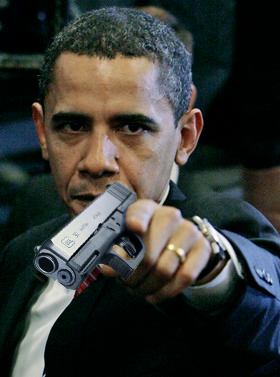
Wait, what begins? Well, this blog, first of all. Second, well, here it is: http://www.policymic.com/articles/22390/obama-may-make-executive-order-on-gun-control-president-would-make-policy-without-using-congress
This is the (possible) beginning of intense Federal gun restrictions. The article tries to be unbiased (good), but its leftward tilt seeps through in its selective reporting of statistics (bad). There are a few flaws with both the idea (executive order) and the article itself (misinterpretation and poor reporting of crime statistics).
But I'm getting ahead of myself. Let's do this piece-by-piece. First of all, the use of executive orders is entirely outside the scope of the Constitution. Presidents used them every now and then, but their use really took off with Theodore Roosevelt, and it's been downhill since then. Now, an executive order enforcing some form of gun control? That's unconstitutional on multiple levels. First, as mentioned, the executive order is in itself illegal. Second, the Federal government - even Congress - has no Constitutional authority to restrict firearms (or anything else, for that matter), even less so the President acting by himself; such regulation is a state issue. Third, well, the Second Amendment makes it pretty clear that the Federal Government cannot infringe on the right to bear arms. I know, I know, it's a tired cliche, but that doesn't make it less true. Again, it's a state issue, not Federal.
Now, for the misinterpretation. The author briefly makes fun of the Drudge Report headline featuring Josef Stalin and Adolf Hitler. First, it should be noted that both of them embarked on mass disarmament before they committed their atrocities, though extrapolating this to Obama's possible action is quite the stretch. However, it's fairly clear from context that the dictatorship theme is purely referencing the idea that the President can make laws on a whim - there, the comparison becomes entirely accurate. We have a Republic, not a monarchy.
As for the selective reporting of crime stats, the author is correct in the percentage of firearm-related homicides. However, the big current push is to ban "assault" weapons (that is, normal rifles that look scary). In this context, integrity would demand that the author acknowledge the fact that rifle homicides are incredibly rare, and are in fact significantly outnumbered by homicides using knives/blades, fists/feet, and hammers/clubs. They are a statistical anomaly, and "assault" weapons account for 1% of homicides. By the way, these stats are from the FBI, not Alex Jones. The vast majority of homicides are committed using small, cheap handguns (especially quiet little .22s), which means that any ban on AR-15s and the like would have no discernable impact on crime rates. We tried it in 1994 - it didn't work.
Subscribe to:
Posts (Atom)